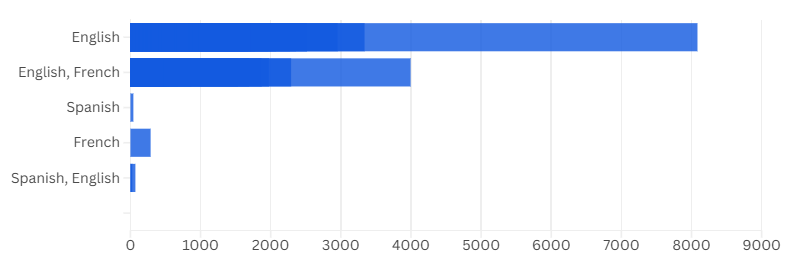
Research question: Of the Mississippi and Louisiana newspapers, what other languages in addition to English were published?
I found it intriguing to delve into the history of newspapers in Mississippi. What started as a question of how many newspapers have existed across the Magnolia State soon took on a greater in-depth look into family history, as oral history claimed an ancestor had started a newspaper in Canton, Mississippi, and a substantiated claim of my great-grandfather starting the Carthaginian newspaper in Carthage, Mississippi. Years ago, before the easier access to digital records, I spent time researching the Canton papers seeking more information, but soon ran into a dead end. It was during the search for this assignment that I was able to confirm and learn more about the Canton connection and my great-great-uncles, one of whom started a paper and worked side-by-side with his brother, then sold the paper, and then the brother bought the paper back years later.
While studying the dataset, I noticed more descriptive information than just the publication name, location, and dates. It was the value of this additional information that piqued my interest as to the diversity of the areas across the state during the 1800s and early 1900s, pertaining to the dialects and languages spoken and read in numerous communities. Were they all written in English? This question soon gave way to the inclusion of Louisiana, known for its language and cultural diversity based on groups who settled in communities with French, Spanish, and Creole influences.
While the inclusion of Louisiana revealed papers written in English, French, and Spanish, it was the inspection of the digitized papers themselves that provided a greater understanding of the information. There were papers that were not wholly in one language or another, but rather, side-by-side columns on the same page with exact articles, one being in English and the other in French or one column being in English and the other in Spanish, thus displaying the deep contrast of readership within the same community.
When reflecting on the three articles from this week’s lesson, about the importance of diversity and inclusion as well as giving representation to more complex data, it was apparent the importance of the extra steps taken with this dataset, as it paints a more accurate picture of the community of this time. Without these specified trails of diversity, a clearer representation of the culture and history would not have been so apparent. While these datasets set in motion an intrigue to make a deeper dive thus revealing multiple primary languages, one also has to wonder if the labeling of languages such as only being English, Spanish, and French is accurate enough to account for the renown creole language or was it not distinguished in the accounting of this set but rather incorporated under one of these broader headings. This is certainly a point to ponder, and additional deep searching to reveal.
Jamie– I also greatly enjoyed working with you in the search for a newspaper dataset and navigating Flourish to create visualizations. The language question is such an exciting (and important) one, and it’s useful to think about how the prevalence of languages can change regionally. One aspect that I deeply appreciate from your research on this is how you pair quantitative and qualitative analysis together; yes, the data is important, but you took the time to explore the histories of newspapers individually, and that is a best practice in DH work.